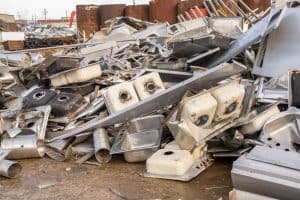

You’ve got stainless on your hands. Maybe it’s a sink and range hood from a remodel, a few prep tables from a restaurant that closed, or offcuts piling up in the shop. You ran a magnet over it, it didn’t stick, and now you’re trying to work out what a Long Island yard will actually pay. Online numbers are all over the map. With this many scrap yards across Nassau and Suffolk, it’s fair to worry about walking away feeling shorted.
Stainless gets simple once someone explains it plainly. Three things set your payout: the grade, the condition and the weight. Let’s start with how the price gets built.
How Stainless Steel Scrap Gets Priced on Long Island
Stainless isn’t priced like steel, and it isn’t priced like copper either. What a yard pays comes down to what’s in the metal, mainly nickel, which makes up roughly 8 to 12 percent of stainless scrap by weight according to the Recycled Materials Association. Nickel moves with the global market, so a stainless steel scrap price that looked good last month can be different today.
That’s why the number you saw on a national website rarely matches the quote you get across the counter. Those sites average a lot of yards and a lot of grades. Your pile is one grade, in one condition, at one weight. At our yard, weight and grade drive every payout, and we’d rather walk you through both than hand you a number and hope you don’t ask.
If you’re trying to price scrap stainless steel before you load up, the first thing to pin down is which grade you have.
How Do You Tell 304 From 316 Stainless Steel Scrap?
By most industry accounts, 304 is the most common stainless grade. It’s the metal in kitchen sinks, range hoods, restaurant prep tables, appliance panels and the shelving you’d pull out of a commercial kitchen in Westbury or Hicksville. 316 looks almost identical, but it carries about 10 percent nickel plus 2 to 3 percent molybdenum, which helps it stand up to salt and chemicals.
That’s why it shows up on boats and marine hardware, in lab and medical equipment, and in fittings and tanks used by food and beverage producers. On Long Island, a boat refit in Huntington or Northport, or a North Fork winery swapping out fittings, can easily put 316 on your truck. And 316 generally pays around double what 304 does.
You can’t see the difference by looking, and that’s the catch. One industry price guide works through the math on 100 pounds of 304. Graded correctly, it’s worth $57.00. Sold as shred, it pays $13.20. That’s $43.80 gone on a single hundred-pound load, just because the grade got flattened.
If you’re not sure what you have, you don’t have to guess. Tell us where it came from, whether that’s a marine job, a commercial kitchen or a lab, and bring it by. We’ll explain what we’re looking at and how we’re grading it while we weigh it, so nothing happens behind a counter you can’t see over.
Does the Magnet Test Work on Stainless Steel Scrap?
It works for one question and fails at the one that costs you money. If a magnet snaps on hard, you’re most likely holding 400-series stainless. That’s the magnetic family, and it sells closer to steel money than stainless money. If nothing sticks, you’re probably holding a 300-series grade like 304 or 316, which is the better-paying group.
That’s where the magnet runs out. It can’t separate 304 from 316, and neither can a spark test or your eyes. It can also fool you the other way. Welding and heavy cold working, like the bends and stamped corners on a formed sink, can make 304 slightly magnetic. So test a flat, undisturbed spot away from any weld or fold. A firm pull and a faint drag mean different things.
Say you’re pulling a range hood out of a kitchen in Great Neck and the magnet doesn’t grab. That’s a good sign, not a verdict. It tells you the metal is probably 300-series, and it leaves the 304-or-316 question wide open. The thought that “if it isn’t magnetic, it must be 304” is exactly how people end up undersold on marine or lab pieces.
When the grade sets the price, the useful move is to ask whoever is buying how they confirm it. A yard that’s happy to talk you through its grading is usually one that grades honestly.
Where to Sell Stainless Steel Scrap in Nassau and Suffolk County
Long Island has no shortage of scrap yards, so you’re allowed to shop around. Whoever you pick should weigh your material in front of you, explain the grade without making you ask twice, and put real numbers on the table. We post ours.
We’re a true industry wholesaler, which means we move material on to end users ourselves instead of passing it through a chain of middlemen. Our equipment lets us process material beyond what most Long Island recyclers can handle, and we buy from other yards and government entities nationwide, so a mixed or oversized load from your job isn’t a problem.
Add over 50 years of grading experience at our Holbrook yard, 1100 Lincoln Ave, and you have a stainless metal scraps buyer who can look at your pile and tell you what it is.
What’s the Difference Between Clean and Dirty Stainless Scrap?
As a rule of thumb, clean stainless is stainless and nothing else. Dirty stainless has other things attached: plastic handles, rubber gaskets, foam or insulation, steel bolts and brackets, or caked-on grease and food residue. The yard has to deal with all of that, and the price reflects it.
Our posted price list shows clean stainless at $.35 a pound and dirty stainless at $.15 to $.25 a pound. That’s a gap of 10 to 20 cents per pound. On a thousand pounds, you’re looking at $100 to $200 either way. Dirty stainless isn’t worthless, but it does cost you. These figures come from our services page, and prices move with the market, so give us a call before you plan around them.
If you need a stainless scrap price for a 316 piece or a mixed load, we’ll quote it off the weigh-in. So how much prep is worth your time? If it’s a five-minute job, like unscrewing a plastic handle, pulling a rubber seal or wiping out a food-service piece, it’s probably worth doing. If it means an afternoon with a grinder, call first and ask what it would actually change on the ticket.
Keep anything you suspect is 316 apart from the rest, and keep magnetic pieces separate from the non-magnetic ones. A sorted load is easier to grade, and it’s easier for you to follow what’s being paid for.
Stainless Steel Scrap Questions From Nassau and Suffolk Sellers
**Is stainless steel ferrous or non-ferrous?** It’s an iron-based alloy, so technically it’s ferrous, but yards price it separately from regular steel because of the nickel. You’ll see it lumped under non-ferrous on some lists, which is where the confusion starts. It’s its own category, and we price it that way.
**Can you pick up a big load?** Yes. We run commercial pickup across Nassau and Suffolk, along with container services. That suits a restaurant kitchen tear-out in Manhasset, a shop cleanout in Hauppauge, or a building job in Syosset. If you’d rather bring it yourself, our Holbrook yard takes drop-offs.
**Is a small load worth the trip?** Stainless doesn’t have to travel alone. Bring it with your aluminum, copper, brass, steel or old electronics and sell everything in one visit. We also take household scrap from Nassau County residents, so one sink and one range hood are welcome.
**What will the visit feel like?** Customers tell us our prices are competitive and transparent, and they describe our staff as helpful and patient about how pricing works. One called our yard “by far the cleanest scrap yard” they had seen. You’ll see the weight, hear the grade, and understand the number before you agree to anything.
Sell Stainless Steel Scrap on Long Island With a Weighed, Graded Quote
Here’s what to take with you. The magnet can rule out 400-series, but it can’t separate 304 from 316, and that’s where the money is. Clean stainless posts at $.35 a pound against $.15 to $.25 for dirty, so a little prep can pay off. And a good yard will show you the weight and explain the grade.
We handle stainless the way we handle everything else at Crestwood Scraps: weighed in front of you, graded out loud, and priced on numbers we post. We also comply with air quality and emissions standards, and stainless can be recycled again and again without losing quality.
If you’ve got a pile in Nassau or Suffolk and aren’t sure what it is, call us at 631-567-2727 or bring it to our Holbrook yard. We’ll tell you what you have and what it’s worth.