
You’ve pulled out a boiler, a couple of radiators and a stack of old pipe. Now you’re staring at a price board that lists light iron at one number, heavy steel at another and cast iron at a third. To you it’s one rusty pile. To us, it’s three or four different products.
Across Nassau and Suffolk County, the same truckload of scrap steel and cast iron can bring noticeably different money depending on how it’s graded. Most yards never explain why. We do. Below you’ll find what each grade is, what we pay for it at our Holbrook yard, and how to sort your load so you’re paid for what you actually have.
Why the Same Pile of Scrap Steel and Cast Iron Pays Three Different Prices on Long Island
Scrap steel and cast iron are both ferrous, which just means a magnet sticks to them. That’s where the similarity ends as far as price goes. Mills buy by grade, so we have to price what we see on your truck the same way.
Here are our posted prices at the time of writing: light iron at $.06 a pound, heavy steel and cast iron at $.09, #1 steel (busheling) at $.10, and rotors and drums at $.11. Those numbers move, because mills reset what they’ll pay for ferrous scrap at the start of each month. Call us to confirm before you load up.
We operate as a true industry wholesaler. We buy from other scrap yards and government entities across the country, so we spend our days looking at material the way a mill does. That’s the view we’ll share here.
What Is Light Iron, and Why Are Light Iron Scrap Prices So Low?
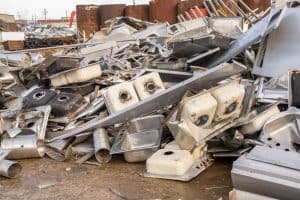
Light iron is the thin stuff. Think sheet metal, appliance shells, and mixed or unprepared scrap that hasn’t been cut down or cleaned up. At $.06 a pound, our posted light iron price works out to $120 per net ton, the lowest of our ferrous grades.
We’re not trying to shortchange you. Thin steel comes with baggage: leftover wiring, oil residue, sealed containers we can’t check inside, and bits of plastic or insulation. Every one of those has to be dealt with before the metal is ready for a furnace, and that processing cost comes out of the price. A 1,000 pound load of light iron comes to $60 at our current number.
This is also where plenty of Long Island sellers get surprised. Say you toss a washer shell, some sheet metal and a few lengths of heavy pipe into one pile. Many yards will price the whole thing by its weakest members, so the heavy pieces end up paid like the thin ones. You never see that happen—you just see a lower number on the ticket.
Light iron is still worth bringing in. Garage cleanouts, old appliances and general tear-out debris are mostly light iron, and it adds up by the ton. The trick is knowing that’s what you have and keeping it apart from the heavier pieces. If you’re not sure whether something counts as light, call us and describe it before you make the drive.
Heavy Steel vs. #1 Steel vs. Cast Iron: What Separates $.09 From $.10?
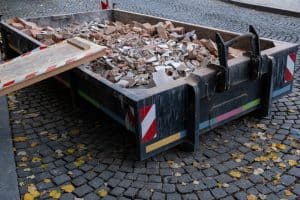
Heavy steel is thicker, prepared material like plate, beams and heavy pipe, cut to sizes a mill can handle. As a rule of thumb, think a quarter inch or thicker and nothing too long to wrestle into a furnace. It needs far less processing than light iron, so it pays $.09 a pound, or $180 a net ton. A thousand pounds is $90.
#1 steel, which we list as busheling, is the cleanest, most prepared steel we buy. It pays $.10 a pound, or $200 a net ton, so 1,000 pounds is $100. What qualifies can be narrower than people expect, so if you think you have some, call and describe it before you load.
Put the grades side by side on a full ton and light iron to #1 steel is an $80 spread. Same magnet, same rust, $80 apart. That’s the whole case for sorting.
Cast iron is the one people assume is worth more. It covers radiators, tubs, engine blocks and old pipe, and it’s dense and brittle, which also makes it easy to break into furnace-ready pieces. At our posted $.09 a pound it pays the same as heavy steel, so 1,000 pounds is $90. It beats light iron but doesn’t beat steel. The exception is brake rotors and drums, which pay a bit more at $.11.
Steel Scrap Price Per Pound vs. Per Ton: Do the Math Before You Drive
Scroll through national scrap sites and you’ll see steel quoted per ton. A yard’s board on Long Island is usually in cents per pound. Neither is wrong, but mixing them up can make a price look better or worse than it is.
A net ton is 2,000 pounds. A gross ton is 2,240 pounds and is the standard for international steel trading, so some pages quote it. To get a per-pound number, divide a net-ton price by 2,000 or a gross-ton price by 2,240.
Going the other direction, our $.06 light iron is $120 a net ton, $.09 is $180, $.10 is $200, and $.11 is $220. Cents per pound feels like nothing until you multiply it out, which is why a steel load only adds up by the ton. Before you compare us to anyone else, make sure you’re comparing the same kind of ton.
How to Sort Scrap Iron and Steel Before Heading to Crestwood Scraps
Start with a magnet. If it sticks, it’s ferrous and goes in your steel-and-iron pile. If it doesn’t, you’re probably looking at aluminum, copper, brass or stainless, which pay on a separate non-ferrous board. That one step keeps your copper from getting paid like iron.
The magnet won’t separate cast iron from steel, since both stick. For that, go by weight and look. Cast iron is heavy for its size, brittle, and usually has a rough, sandy surface. A radiator or old tub is the classic example. Steel is more likely to be bent, cut or welded, and it flexes before it breaks.
Next comes thickness. Thin and bendy goes with light iron, and thick, solid pieces go with heavy steel. If you’re in the middle of a boiler swap, a plumbing rip-out or a garage cleanout, you’ll probably end up with all three. Make separate piles where you’re working instead of one big heap in the truck bed.
Then strip off what isn’t metal. Wood, plastic, concrete, rubber and attached parts add weight that isn’t worth anything, and too much of it can lower what you’re paid. Empty anything sealed, because we can’t price a container we can’t see into.
Last, if you’ve got non-ferrous metal, set it aside and tell us. We do pickup for non-ferrous metals in Suffolk County, while steel and iron come to our yard at 1100 Lincoln Ave. in Holbrook. Sorting takes maybe ten minutes, and it’s one of the few parts of the ticket you control.
Tubs, ID and Town Pickup: What Nassau and Suffolk Sellers Ask Us Most
Is an old cast iron tub worth hauling in? A tub runs about 250 to 400 pounds, so at $.09 a pound you’re looking at roughly $22.50 to $36. A 285 pound tub comes to $25.65. If yours is in good shape, it may resell for far more than scrap value, so check that first. A heavily rusted tub, or one with non-metal parts still attached, may be paid less or turned away.
Do I need ID? Yes. Suffolk County Code Chapter 721 requires scrap dealers to keep records on the people we buy from, so we ask for photo ID and log what you bring. It’s a legal requirement across Long Island, not a hassle—it protects both of us.
Can’t I just leave it with the town? Usually not. Curb programs in places like Smithtown, Brookhaven and Islip only count cans and containers as metal. Bulky items such as an old water heater or aluminum siding need a drop-off site, like Brookhaven’s facility in Yaphank, or a scrap yard like ours. Islip sets its own rules, so check there first.
Should I wait for prices to climb? Mill prices reset monthly, so ferrous moves in steps. In 2008 prices dropped by close to half, and people who stockpiled and waited got burned. Unless you have a real reason to hold, waiting is a gamble.
If your ticket comes in under the posted price, it’s almost always grading: mixed grades, dirt or non-metal weight. Ask us and we’ll walk you through it.
Sell Your Scrap Steel and Cast Iron to Crestwood Scraps on Long Island
Light iron, heavy steel, #1 steel and cast iron all stick to a magnet and all look rusty, but they’re priced differently for reasons that make sense once you see how mills buy. Sort first, know your per-pound numbers, and bring photo ID.
At Crestwood Scraps, we post our ferrous prices, weigh with precision and explain the ticket. Customers tell us our prices are competitive and transparent, and some have been coming back for more than ten years. We serve sellers across Nassau and Suffolk County from our yard in Holbrook.
Over 50 years in the business and our position as a true industry wholesaler mean we can talk through whatever you’re hauling. Give Crestwood Scraps a call before you load the truck. We’ll confirm today’s prices and hours and tell you what to expect when you pull in.